
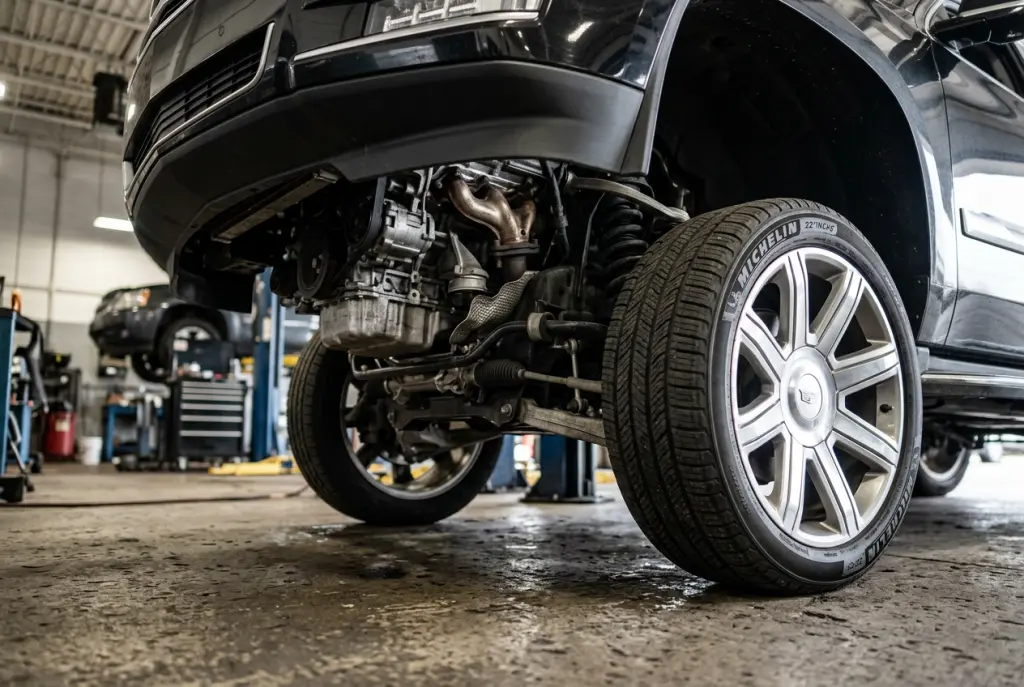
Power running boards on a Cadillac Escalade, GMC Yukon Denali, or a loaded Chevy Tahoe or Suburban should extend when you open the door and retract when you close it. When they stop, the most common causes are a seized actuator motor, a corroded or binding linkage, or a failed wiring connector. This is a known pattern on these trucks, commonly reported on roughly 2007-2022 models.
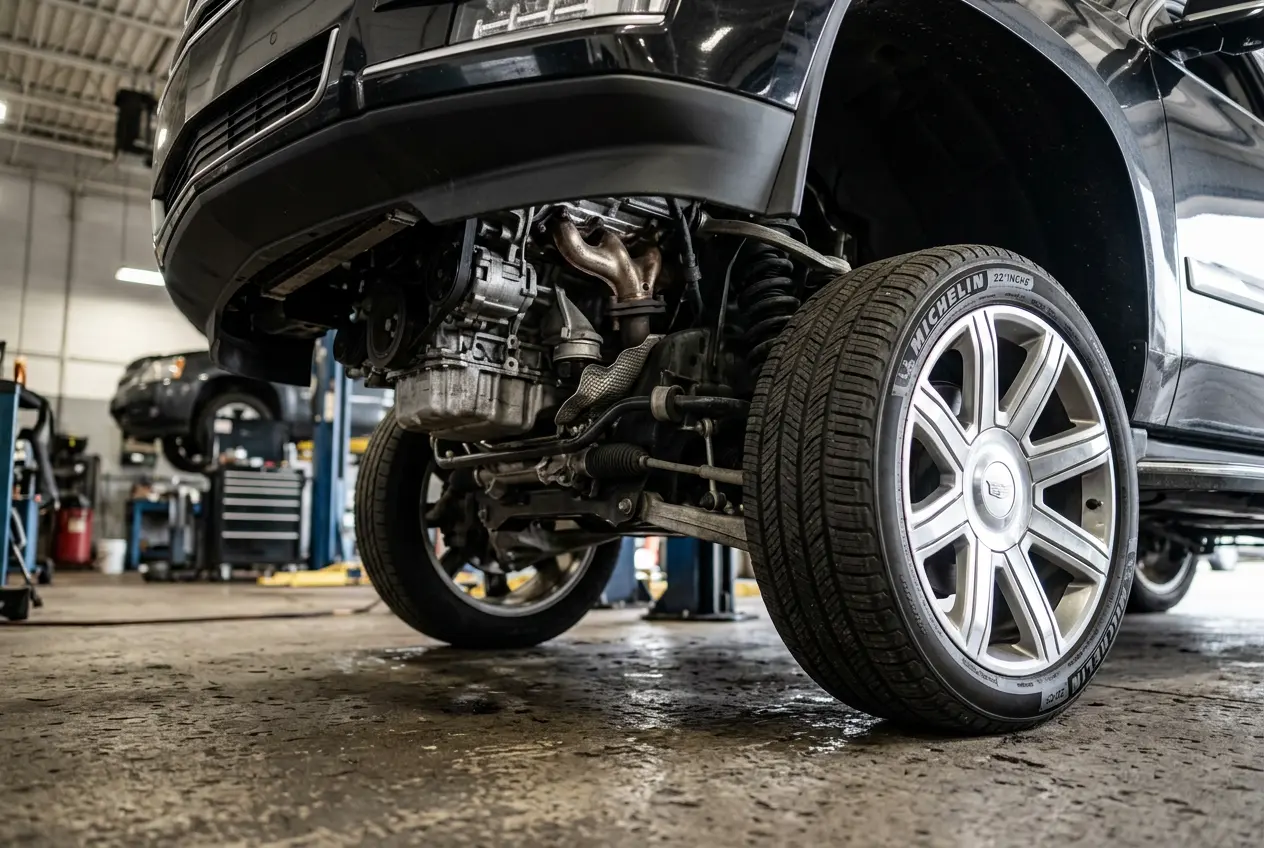
What exactly are power retractable assist steps?
Power assist steps are motorized running boards that fold out from under the rocker panel when a door opens and tuck back up when the door closes. Each step is driven by a dedicated actuator motor and a gear-driven linkage arm. The system gets a signal from the door-ajar switch and runs through a body control module. When any part of that chain fails, the step stops moving.
Why do Escalade and Denali power steps fail?
The commonly diagnosed root cause is actuator motor or gear seizure, often combined with corroded linkage pivots and degraded wiring connectors. These steps live directly in the wheel well spray zone. Every winter, road salt coats the linkage arms, the motor housing, and the connector pins. Repeated freeze-thaw cycles work moisture into pivot points and connector seals. Over time the motor has to work harder to move a stiff linkage until it burns out or the gears strip.
Here in southern Wisconsin, the freeze-thaw cycle runs from November through March, and roads are salted repeatedly throughout that stretch. That is just what happens to undercarriage components on vehicles that spend winters here. The Beltline and city streets alike leave a salt residue that builds up season after season on anything mounted low on the rocker panel.
What are the symptoms, from early to late?
| Stage | What you notice | Likely cause | Urgency |
|---|---|---|---|
| Early | Step moves slowly or hesitates before extending | Stiff linkage pivot, partial connector corrosion | Low, inspect soon |
| Mid | Step grinds, clicks, or only moves partway | Worn actuator gears, binding linkage arm | Medium, schedule repair |
| Late | Step stays fully down or fully up and does not respond | Dead actuator motor, broken gear, open circuit in harness | High, step can snag on obstacles |
| Late | Step moves on one side only | Failed actuator or connector on the non-working side | Medium-high, other side likely to follow |
Is it safe to keep driving with the steps stuck down?
Driving with the steps stuck in the extended position reduces ground clearance by several inches. On city streets that is mostly a nuisance. On a snow berm, a parking curb, or a rough road, a hanging step can catch and bend the linkage arm, tear the motor mount, or damage the rocker panel. If the step is stuck down, avoid tight parking situations and get it diagnosed promptly. A step stuck in the retracted position is less urgent but still worth fixing before the motor seizes completely.
How is the repair done?
The standard procedure starts with a visual inspection of the linkage arms, pivot pins, and actuator housing for corrosion and physical damage. The connector is unplugged and the pins are inspected for oxidation. If the motor is suspect, voltage and ground are tested at the connector before the motor is condemned. A seized linkage is cleaned, freed, and lubricated at every pivot point. A failed actuator motor is replaced as an assembly. Corroded or damaged wiring is repaired or replaced section by section. After reassembly, the step cycle is tested through multiple door open-close cycles to confirm smooth, full travel.
What does the repair cost?
There is no honest single number without seeing the vehicle, because several things move the price:
- Connector cleaning only: The lowest-cost outcome if the motor tests good and only the connector is corroded.
- Linkage cleaning and lubrication: Labor-only job if the motor is fine and the pivots are just stiff.
- Actuator motor replacement (one side): Parts cost varies by model year and whether the motor is available separately from the full step assembly. Labor is typically two to three hours per side.
- Full step assembly replacement: Some years and trim levels require replacing the entire power step unit if the motor is not sold separately. This is the most expensive outcome.
- Wiring harness repair: Adds time and parts cost if corrosion has reached the body-side harness.
Bert Fuller, owner and ASE Certified Master Technician, and the Wrench Auto Service team will give you a firm estimate after a diagnostic inspection. No invented number is better than a real one based on your specific truck.
Should I check for a recall before paying for this repair?
Recall status for power step failures on these trucks is currently unconfirmed. Before authorizing any paid repair, run your VIN through the NHTSA recalls lookup to check for any open recalls. You can also contact Cadillac owner support directly with your VIN if you own an Escalade. If a recall does exist for your VIN, that work is done at the dealer at no charge. Out-of-warranty repairs for vehicles not covered by a recall are what an independent shop handles.
For related electrical and diagnostic issues on GM trucks, see our post on GM 5.3L oil consumption issues and our overview of why a code reader is not enough for a proper diagnosis. If your truck has other electrical gremlins, our engine repair and diagnostics page covers what a full diagnostic inspection involves. We also serve drivers coming in from Cross Plains and Arbor Hills.
Frequently Asked Questions
Can I still drive with the power steps stuck in the down position?
Yes, but it is not ideal. Steps hanging down reduce ground clearance and can catch on curbs, snow berms, or debris. Get them looked at before they snag something and cause damage to the linkage or the vehicle body.
Will the steps work manually if the motor fails?
On most systems the steps are motor-driven only and do not have a manual override. If the motor or actuator fails completely, the steps stay wherever they stopped.
How long does the repair usually take?
A straightforward actuator replacement or linkage cleaning typically takes two to four hours. If corrosion has spread to the wiring harness or connectors, add time for that work.
Is this covered under any warranty or recall?
Recall status for this issue is currently unconfirmed. Check your VIN at nhtsa.gov/recalls to see if any open recalls apply to your vehicle. Out-of-warranty repairs are performed at the owner’s cost.
Do I need to replace both sides at the same time?
Not always, but if one side has a failed motor due to corrosion, the other side is often not far behind. A technician can inspect both and give you an honest assessment.
Ready to get your power steps working again?
Bring your Escalade, Denali, Tahoe, or Suburban to Wrench Auto Service at 3113 Laura Ln, Middleton, WI. Bert Fuller, owner and ASE Certified Master Technician, and the Wrench Auto Service team will inspect the actuator, linkage, and connectors and give you a straight answer on what it needs. Every repair is backed by a 3-year/36,000-mile warranty. Free loaner cars and shuttle service are available, and after-hours drop-off is an option if your schedule is tight.
Sources

Meet Bert, Wrench Auto’s owner! With more than 30 years of experience in the automotive repair industry, his commitment to excellence has earned him ASE certification as a Certified Master Technician with an L1 Advanced Engine Performance Specialist designation. He is also a Master ASE Engine Machinist and ASE Undercar Specialist. Bert graduated from Madison Area Technical College’s Automotive Technology program with an Associate Degree in Applied Science. He enjoys the daily challenges the automotive industry presents and takes pride in helping customers keep their vehicles running reliably. Outside of work, Bert enjoys spending time with his wife, Kelli, their two daughters, and their dog, Scout. Together, they enjoy camping, boating, fishing, snowmobiling, and other outdoor family activities.