
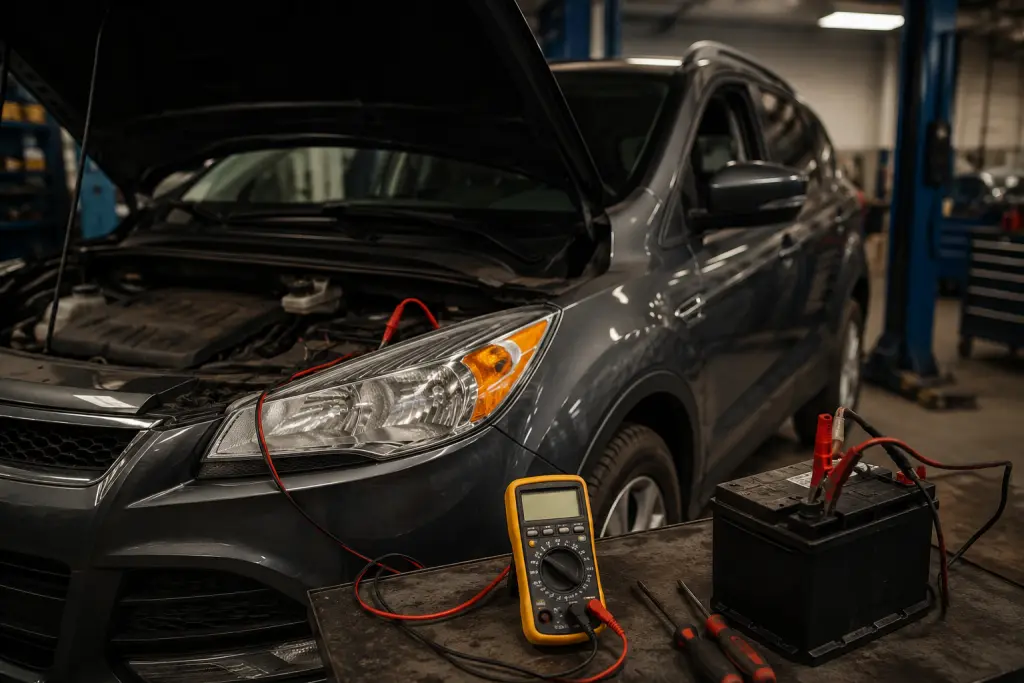
At Wrench Auto Service, we’ve built our reputation in Middleton, WI by solving the kinds of problems that leave drivers frustrated and stranded. Our team focuses on accurate diagnostics and long-term solutions, not guesswork or unnecessary part replacements. Ford Escape battery drain issues are one of the most common electrical concerns we diagnose, especially given the driving conditions and seasonal temperature swings we see throughout Wisconsin.
If you’ve ever walked out on a cold morning, turned the key in your Ford Escape, and been met with nothing but a slow crank or complete silence, you’re not alone. If your Ford Escape is dead in the morning but was working fine the night before, you’re likely dealing with more than a weak battery. In our shop, we frequently work with customers who are dealing with vehicles that seem perfectly fine one day and completely dead the next. This is something we see on a weekly basis, especially during colder months in Middleton. In most cases, this isn’t just a failing battery—it’s a deeper issue within the vehicle’s electrical system that requires proper testing to identify.
What Ford Escape Drivers Notice Before a No-Start Condition
Battery drain issues rarely happen without warning. In many cases, there are subtle signs that something isn’t right long before the vehicle fails to start. One of the most common things drivers report is a slower crank when starting the vehicle, particularly in the morning. While this is often brushed off as a weak battery, it can also indicate that the battery is not being fully charged or is being drained while the vehicle is off.
Another issue we hear about frequently is intermittent electrical behavior. This might include dashboard lights flickering, infotainment systems resetting, or warning messages appearing briefly and then disappearing. These types of issues can point to voltage instability, which is often tied to battery or charging system problems. Over time, these inconsistencies can become more frequent, eventually leading to a complete failure to start.
Here in Middleton, WI, colder temperatures play a major role in making these issues more noticeable. Batteries naturally lose efficiency in the cold, and any underlying electrical problem becomes more pronounced. A battery that performs adequately in mild weather may struggle significantly once temperatures drop, especially if the vehicle is used primarily for short trips that do not allow the alternator to fully recharge the battery.
What We Commonly Find in the Shop With Ford Escape Battery Drain
When a Ford Escape comes into our shop with a no-start condition, we take a deeper look beyond the battery itself. While batteries do wear out over time, many of the cases we see involve parasitic draws within the vehicle’s electrical system.
A parasitic draw occurs when a component continues to use power after the vehicle has been turned off. In modern vehicles like the Ford Escape, multiple electronic modules are constantly communicating and managing systems. If one of these modules fails to enter sleep mode, it can slowly drain the battery over several hours.
We commonly see issues involving the body control module, infotainment systems, or even wiring faults that keep circuits active when they should be inactive. In some cases, aftermarket accessories or aging electrical connections can also contribute to the issue. These types of problems are not something that can be identified by simply replacing a battery—they require a systematic diagnostic approach.
Another contributing factor we often see is driving habits. Many drivers in the Middleton and Madison areas use their vehicles for short commutes, errands, and stop-and-go driving. If the vehicle is not run long enough to recharge the battery fully, even a small electrical draw can eventually lead to a dead battery. Over time, this repeated cycle of partial charging and discharge weakens the battery and reduces its ability to hold a charge.
How We Diagnose Battery Drain Issues Step by Step
Proper diagnosis is the most important part of resolving battery drain issues. In our shop, we start by verifying the condition of the battery itself. This includes performing a load test to determine whether the battery can hold and deliver power under demand. A battery that fails this test will need to be replaced, but we still continue testing to ensure there are no underlying issues.
Once the battery has been evaluated, we move on to testing the charging system. This ensures that the alternator is functioning correctly and supplying the proper voltage while the vehicle is running. If the charging system is not operating as it should, the battery may not be replenished after each drive, which can lead to repeated failures.
From there, we perform a parasitic draw test. This process involves measuring the electrical current being pulled from the battery when the vehicle is off. Every vehicle has a small amount of normal draw to maintain memory in certain systems, but excessive draw indicates that something is staying active when it shouldn’t be. In most modern vehicles, we expect to see draw levels drop below roughly 50 milliamps after all systems go to sleep. Anything significantly above that is a clear sign that a module or circuit is not shutting down properly.
To isolate the issue, we methodically test individual circuits and components. This allows us to pinpoint the exact source of the drain, whether it’s a faulty module, wiring issue, or another electrical fault. If left unresolved, these types of problems can escalate and eventually require more extensive engine repair in Middleton WI.
Repair Solutions and When to Take Action
Once the source of the battery drain is identified, the repair process is tailored to the specific issue. In some cases, replacing the battery may be necessary if it has been weakened by repeated discharges. However, in many situations, the root cause lies within the electrical system rather than the battery itself.
Repairs may involve replacing a faulty module, repairing damaged wiring, or addressing issues within the charging system. The goal is to eliminate the source of the parasitic draw and restore the system to normal operation. This ensures that the battery can maintain a full charge and operate reliably.
Timing is critical when it comes to addressing these issues. If you find yourself needing to jump-start your vehicle more than once, or if it consistently struggles after sitting overnight, it’s a clear indication that something is wrong. If this situation sounds familiar, it is worth having the vehicle tested before it leaves you stranded in an inconvenient or unsafe situation. Addressing the issue early can prevent further damage and reduce the likelihood of being stranded.
Our team provides comprehensive auto repair in Middleton WI and diagnostic services designed to identify these problems accurately and resolve them efficiently.
What Happens If You Ignore a Battery Drain Problem
Ignoring battery drain issues can lead to more than just inconvenience. Repeated deep discharges can significantly shorten the lifespan of your battery, eventually leading to complete failure. Over time, this can also place additional strain on other components within the starting and charging system.
We’ve seen cases where unresolved electrical problems lead to damage in related systems, including the starter and even engine performance concerns. What starts as a simple no-start issue can evolve into a more complex and costly repair if not addressed in a timely manner.
Battery drain can also mask other developing problems within the vehicle’s electrical system. Without proper diagnostics, these issues can go unnoticed until they create larger failures that require more extensive repairs. This is why a thorough inspection is always recommended when repeated battery problems occur.
For additional peace of mind, drivers can check for known recalls or safety-related issues through the NHTSA website. However, most of the battery drain problems we diagnose are not tied to recalls and require hands-on testing to properly resolve.
Frequently Asked Questions About Ford Escape Battery Drain
Why does my Ford Escape battery keep dying overnight?
In most cases, this is caused by a parasitic draw within the electrical system, where a module or circuit continues pulling power after the vehicle is turned off.
What causes parasitic battery drain in a Ford Escape?
Parasitic drain is typically caused by modules failing to enter sleep mode, wiring faults, or electrical components that remain active when they should not.
Can cold weather kill a car battery overnight?
Cold weather reduces battery efficiency, but it usually exposes an existing weakness rather than being the sole cause of an overnight failure.
Schedule Your Battery Diagnostic in Middleton WI
If your Ford Escape has left you dealing with repeated no-start situations, it is important to address the issue before it becomes more serious. The last place you want to be is stuck with a vehicle that will not start when you need it most. Electrical problems rarely resolve themselves, and the longer they go unchecked, the more likely they are to lead to additional damage or unexpected breakdowns.
At Wrench Auto Service, our ASE-certified technicians take a diagnostic-first approach to every vehicle we see. We focus on identifying the root cause of the problem so you are not dealing with the same issue again weeks or months down the road. Our experience with Ford Escape electrical systems allows us to quickly narrow down the source of the problem and recommend the most effective solution.
If you are ready to get your vehicle properly diagnosed and fixed, contact our Middleton auto repair team today or call us directly at 608-831-5557.

Meet Bert, Wrench Auto’s owner! With more than 30 years of experience in the automotive repair industry, his commitment to excellence has earned him ASE certification as a Certified Master Technician with an L1 Advanced Engine Performance Specialist designation. He is also a Master ASE Engine Machinist and ASE Undercar Specialist. Bert graduated from Madison Area Technical College’s Automotive Technology program with an Associate Degree in Applied Science. He enjoys the daily challenges the automotive industry presents and takes pride in helping customers keep their vehicles running reliably. Outside of work, Bert enjoys spending time with his wife, Kelli, their two daughters, and their dog, Scout. Together, they enjoy camping, boating, fishing, snowmobiling, and other outdoor family activities.