
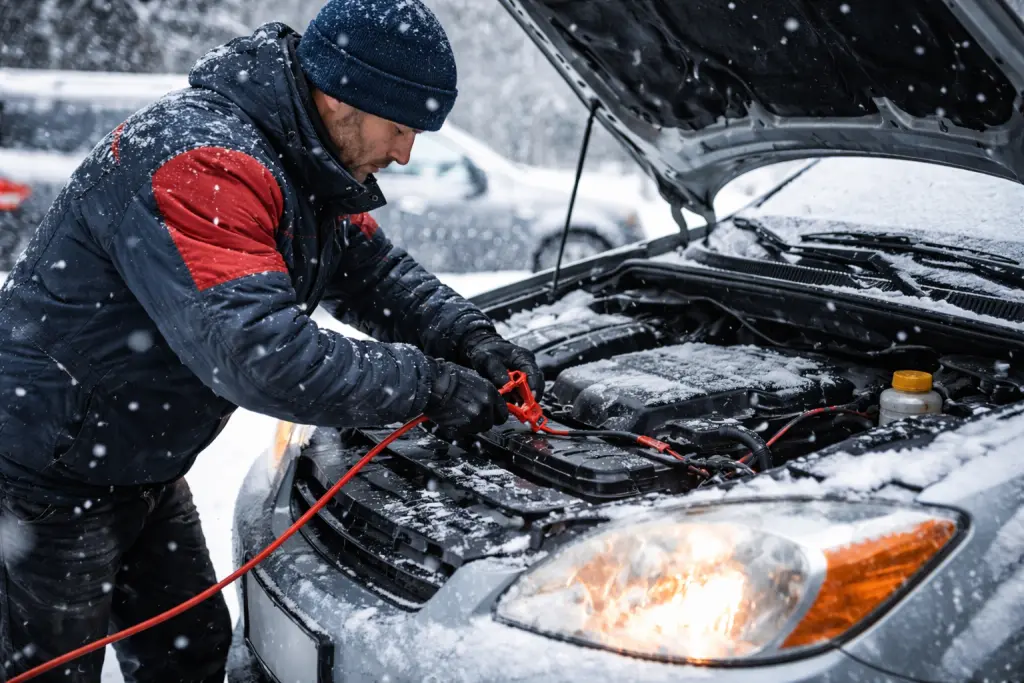
Why Winter Starting Problems Happen in Middleton, WI
You walk outside on a freezing Middleton morning, turn the key or push the button, and nothing happens. Maybe you hear a slow crank, maybe just a click. This situation is frustrating for any driver, whether you own a Toyota RAV4, Subaru Outback, Honda CR-V, or Ford F-150, especially if you recently replaced the battery.
At Wrench Auto Repair in Middleton, WI, this is a common issue we see every winter. In many cases, the battery is not the real problem. Cold weather places added strain on multiple systems in your vehicle, and those stresses reveal weaknesses that are easy to miss during warmer months.
In Wisconsin, overnight temperatures can drop quickly, and repeated cold starts compound wear on the starting and charging systems. What seems like a one-time inconvenience can quickly become a pattern if the root cause is not identified. Our approach is to diagnose the system as a whole so you are not left guessing or replacing parts unnecessarily.
How Cold Weather Affects Your Starting and Electrical Systems
Cold weather affects several critical systems in your vehicle, not just the battery. As temperatures drop in the Middleton and Madison area, engine oil thickens, making it harder for the engine to turn over. Battery output is reduced even when the battery is in good condition, and electrical resistance increases throughout the system.
Lower temperatures also reduce chemical activity inside the battery, which means it cannot deliver the same level of power it would in warmer conditions. At the same time, the engine requires more effort to start, creating a mismatch between available power and required effort. This combination is why vehicles that seem reliable in the fall can suddenly struggle once winter conditions set in.
In our shop, we frequently see drivers of vehicles like Toyota RAV4s, Subaru Outbacks, Honda CR-Vs, and Ford F-150s assume the battery is failing. In reality, winter conditions are exposing deeper issues within the starting or electrical system. Proper testing is the only way to accurately identify the cause.
If your vehicle is struggling to start, it may be time to schedule a professional diagnostic service to identify the root issue before it worsens.
The Most Common Reasons Cars Won’t Start in Cold Weather
Most winter starting problems come down to a handful of systems working together under stress. In cold conditions, even minor weaknesses become noticeable.
A weak battery is often part of the issue, but rarely the entire cause. Reduced battery efficiency combined with increased demand from the engine can push the system past its limit. At the same time, the starter motor must work harder to turn over a cold engine, and any weakness in that component becomes more obvious.
Electrical connections also play a major role. Corrosion from road salt is extremely common in Wisconsin and can reduce the flow of electricity throughout the system. Even a small amount of resistance can prevent the vehicle from starting reliably in low temperatures.
Charging system performance is another factor. If the alternator is not maintaining proper battery charge, the vehicle may start intermittently or fail after sitting overnight. These issues are often overlooked because the vehicle may still operate normally during the day.
These problems are rarely isolated. In many cases, multiple small issues combine to create a larger starting failure. This is why a complete system evaluation is more effective than replacing individual parts.
Hidden Issues We Commonly Diagnose in Winter Months
When vehicles struggle to start in cold weather, we often find issues beyond the battery itself. This applies across many makes and models, including Toyota, Subaru, Honda, and Ford vehicles.
A weak starter motor is one of the most common causes. It may function normally in mild temperatures but fail under the added strain of cold weather, resulting in slow cranking or inconsistent starts. Corroded or loose electrical connections are another frequent issue. Road salt accelerates corrosion on terminals and grounding points, reducing voltage delivery to critical systems.
A failing alternator can also contribute to repeated starting problems. Even with a new battery, the system cannot function properly if the battery is not being recharged effectively. In addition, parasitic electrical drains can slowly reduce battery charge overnight, especially in colder conditions when the system is already under strain.
We also encounter situations where sensors or ignition components behave inconsistently in low temperatures. These types of issues are difficult to identify without proper diagnostic equipment and real-world testing conditions.
Replacing parts without confirming the root cause often leads to repeated failures and unnecessary costs. Accurate diagnostics ensure the correct repair is performed the first time.
Real-World Patterns and Mistakes We See in Our Shop
One of the most common mistakes we see in Middleton is replacing the battery multiple times without performing a full system diagnosis. Customers often assume the battery is the issue because the symptoms seem to point in that direction, but the underlying cause is frequently something else.
We recently worked with a customer who installed two new batteries in one winter. The real issue turned out to be a failing starter combined with a corroded ground connection. Once those components were addressed, the vehicle started reliably again.
Another pattern we see involves vehicles that start normally during the day but fail after sitting overnight. This usually indicates a charging issue or a parasitic draw rather than a defective battery. Without proper testing, these problems can go undetected for long periods.
Many drivers also ignore early warning signs such as slow cranking or dimming lights. These symptoms are often dismissed as normal winter behavior, but they typically indicate a deeper issue that will continue to worsen.
At Wrench Auto Repair, our ASE-certified technicians focus on identifying the exact cause of the problem. This prevents unnecessary repairs and ensures long-term reliability.
Preventing Cold Weather Starting Issues Before They Leave You Stranded
Preventing winter starting problems begins with proactive inspection and maintenance. A complete electrical system evaluation before winter can identify weak components before they fail under cold conditions.
Battery terminals and connections should be kept clean and secure. Even minor corrosion can significantly impact performance when temperatures drop. Addressing these small issues early can prevent larger failures later.
Drivers should also take slow starts seriously. Hesitation during startup is often an early indicator of a developing problem. Addressing it early can reduce the likelihood of a breakdown.
Using the correct engine oil for winter conditions can also improve performance. Oil that flows properly in low temperatures reduces strain on both the engine and the starter.
If you are already noticing slow starts or hesitation, it is a good idea to have your starting system inspected before winter conditions worsen. Scheduling a vehicle inspection early can help you avoid unexpected breakdowns.
Why Drivers in Middleton Choose Wrench Auto Repair
Wrench Auto Repair has been serving Middleton and the surrounding Madison area since 2002. Our reputation is built on accurate diagnostics, honest recommendations, and dependable service.
Our ASE-certified technicians specialize in complex electrical and starting system issues. We use advanced diagnostic tools to identify problems quickly and accurately rather than relying on trial-and-error repairs.
We stand behind our work with a 3-year or 36,000-mile warranty and offer conveniences such as loaner vehicles, shuttle service, and after-hours pickup and drop-off. These services are designed to make the repair process as simple and stress-free as possible.
Our goal is to fix the problem correctly the first time so you can rely on your vehicle throughout the winter season.
FAQ
Why does my car struggle to start in cold weather even with a new battery?
Cold temperatures reduce battery efficiency and increase resistance throughout the electrical system. If other components such as the starter or alternator are weak, the problem becomes more noticeable.
How can I tell if the issue is my starter or something else?
A slow crank or clicking sound often points to a starter issue, while inconsistent starting after sitting overnight may indicate a charging or electrical problem. Proper diagnostic testing is the most reliable way to determine the cause.
When should I have my vehicle inspected for winter starting issues?
If you notice slow starts, dim lights, or intermittent starting problems, it is best to have your vehicle inspected before temperatures drop further to prevent being stranded.
Schedule Service with Wrench Auto Repair
If your vehicle is struggling to start in cold weather, it is important to address the issue before it leads to a complete failure. We commonly see this across a range of vehicles, including Toyota RAV4, Subaru Outback, Honda CR-V, and Ford F-150 models. What may seem like a simple battery problem is often a deeper electrical or mechanical issue that requires professional diagnosis.
Scheduling a service with an experienced local shop can help you avoid unexpected breakdowns and costly repairs. Taking action early ensures your vehicle remains reliable throughout the winter season.
Schedule your service with Wrench Auto Repair or call (608) 831-5557 to speak directly with our team.

Meet Bert, Wrench Auto’s owner! With more than 30 years of experience in the automotive repair industry, his commitment to excellence has earned him ASE certification as a Certified Master Technician with an L1 Advanced Engine Performance Specialist designation. He is also a Master ASE Engine Machinist and ASE Undercar Specialist. Bert graduated from Madison Area Technical College’s Automotive Technology program with an Associate Degree in Applied Science. He enjoys the daily challenges the automotive industry presents and takes pride in helping customers keep their vehicles running reliably. Outside of work, Bert enjoys spending time with his wife, Kelli, their two daughters, and their dog, Scout. Together, they enjoy camping, boating, fishing, snowmobiling, and other outdoor family activities.